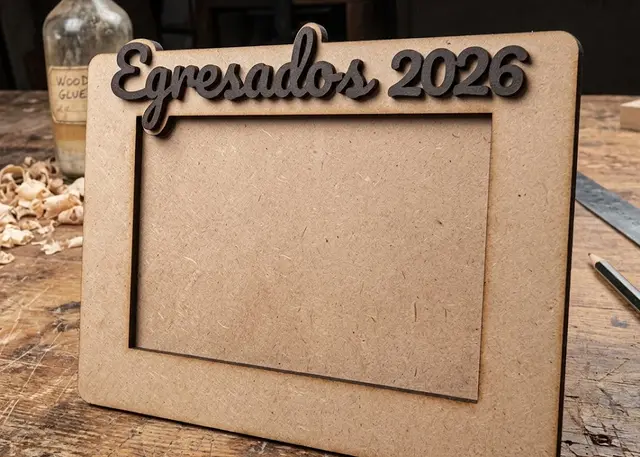
Photo frame Pro
A three-layer frame made to the size of your photo, with a slot to slide it in and a stand or holes to hang it.
The window smaller than the photo and the slot bigger, and a leg that jams itself in its own slot.
How it goes together
The three layers do not measure the same, and that is the whole thing. The window is smaller than the photo — if it measured the same, the photo would fall through the opening — the spacer is bigger — otherwise the photo would not go in — and the outline is identical on all three, because they glue one on top of the other.
You glue the three together and the photo stays inside. Back, spacer and front, in that order. Only glue the layers to each other: if glue reaches the slot, the photo can never be changed again.
With the slot, the photo goes in from the top. That is why the spacer is a U and not a ring: the bar at the top is precisely the mouth it slides through. Without the slot it looks tidier, but the photo is glued inside for good.
The leg is slotted in, not glued. It goes through a slot in the bottom margin of the back, and what holds it is neither a stop nor glue: it goes in at an angle through a slot exactly the width of the material, and a board pushed diagonally into a slot of its own thickness jams itself. That is why the clearance is so small — it is the difference between gripping and falling — and why it is worth measuring the real thickness with a caliper.
The spacer carries the same opening as the back. Without it the leg hits it and stops one thickness short of going in, which is exactly what it needs to jam. The tilt is adjusted by pushing it further in or less.
The text can go on three ways, and they are not equivalent. Glued on comes out as a separate piece and glues on top: it stands out in relief and you can make it in another wood or paint it. Cut out goes through the front, so through the letter you see the spacer behind — it looks great if you paint that layer another colour, and it is the only one that never comes unstuck. Engraved only marks the surface: it is the quickest, but it does not read from a distance.
Cut out, the centres of the letters fall out. The hole in an "o" leaves its centre loose, with nothing holding it: it has to be glued back by hand after cutting. The template tells you how many there are before you download. Glued on and engraved do not have that problem.
Glued on, the outline engraved on the frame is the guide. It is the same text, slightly larger. Freehand the letters always come out crooked; following the outline they end up where they should, and it reads as a shadow around them.
If you want glass or acetate, add its thickness to the clearance: the slot has to make room for the photo and the glass together.
Frequently asked questions
Photo frame: what size can it be?
Every measurement is typed in millimetres and the drawing is redone as you type: width, from 20 to 1000 mm, height, from 20 to 1000 mm and overlap, from 0.5 to 30 mm. Everything else — joints, dividers, holes — is worked out from those measurements.
Does it work for MDF, acrylic or plywood?
For any sheet your laser can cut: MDF, plywood, acrylic or thick card. What matters is the thickness, adjustable from 0.5 to 20 mm, and the kerf — what the beam eats away: the joints are drawn from those two numbers, so they push together without sanding.
What format does it download in?
SVG or DXF, your choice, in millimetres and at 1:1 scale. It opens as is in LightBurn, RDWorks, LaserGRBL, Inkscape, Illustrator or CorelDRAW, with nothing to scale or convert. Cutting and engraving come on separate named layers — “Cut” in red and “Engrave” in blue — so you set the power for each without separating anything by hand.
Do I have to pay to use it?
Photo frame is free to use and adjust: you can see exactly how your design will come out before deciding anything. Downloading the file needs the Pro plan, or one of the trial downloads that come with the free account.
Others you might need
-
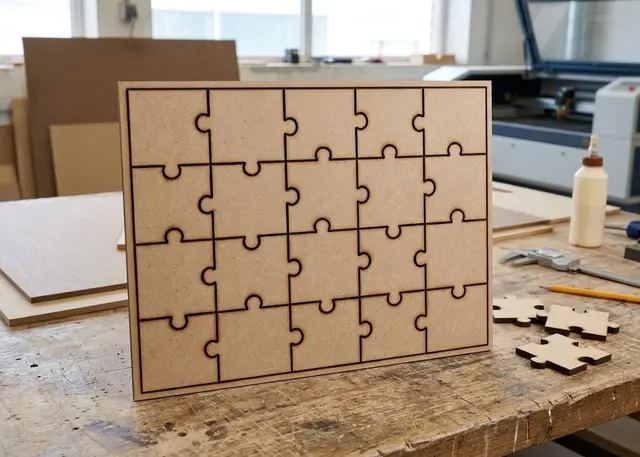 Photo jigsaw puzzle The cut lines of a jigsaw made to the size of your photo: rows, columns and tabs that really do lock together.
 -
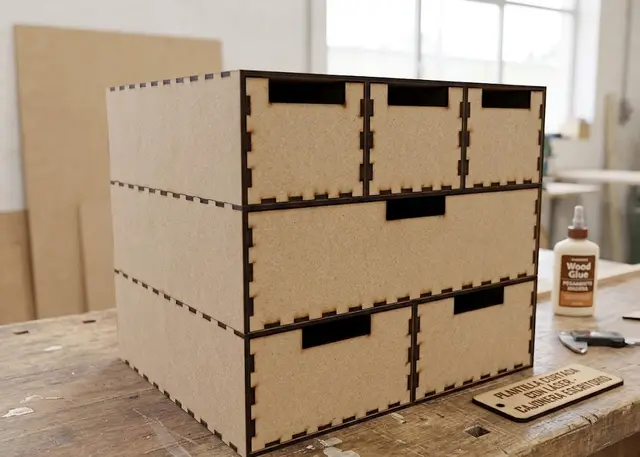 Desk drawer unit A made-to-measure drawer unit: you pick how many rows, how tall each one is and how many drawers fit in it.
 -
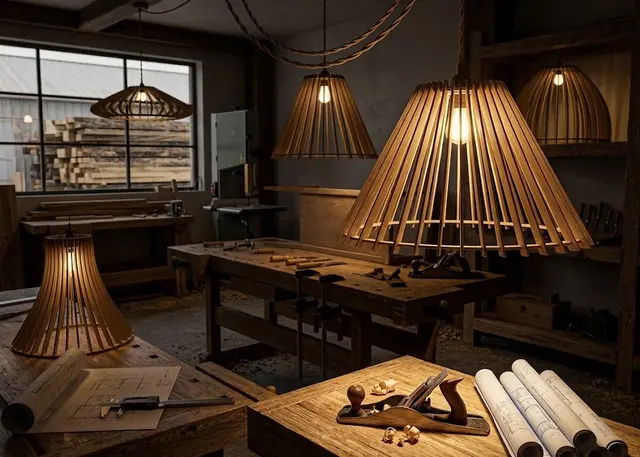 Slatted lamp A hanging lamp made of rings and slotted slats: cone, globe, bell or tulip, with the hole for the lamp holder.