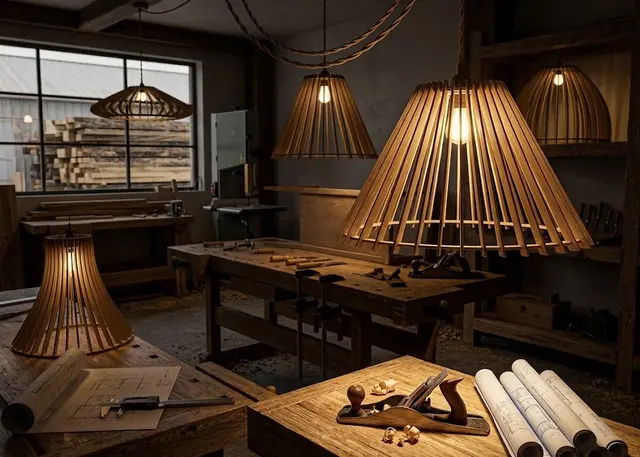
Slatted lamp Pro
A hanging lamp made of rings and slotted slats: cone, globe, bell or tulip, with the hole for the lamp holder.
Rings and slats that interlock halfway, with no glue. Four profiles, as many slats as you like and the holder hole made to measure.
How it goes together
Use an LED bulb. A filament or halogen bulb inside a wooden shade gets too hot. The holder hangs from the cable, resting on the top ring, and the LED sits a few centimetres away from the wood.
Everything interlocks halfway. Each ring has one slot per slat and each slat one slot per ring, both cut halfway: where they cross, the faces end up flush. They push-fit, with no glue, and the lamp can be taken apart to store or move.
Start with the top ring. Fit the slats one at a time, opposite each other — one, then the one across from it, then the ones in between — so the ring does not go out of true. The bottom ring goes on last, pushing evenly all round.
It can go up without taking the fitting apart. A shade is normally held by unscrewing the ring on the lamp holder, slipping the top ring in and screwing it back on: the fitting has to come down from the ceiling. With the hanging disc it does not: it is a disc with a “C” slot that goes in through the opening at the bottom of the shade — always the wider one — and jams against the hole at the top, which is smaller than the disc. You slide it sideways around the cable —or the tube coming out of the holder— and let go: the disc rests on the holder and the shade rests on the disc. The slot is as wide as whatever it hugs, which is what lets it go on sideways with nothing unplugged or taken apart; a touch narrower than the cable and it grips, so the disc will not slide about.
The profile comes from two diameters and the belly. Small at the top and wide at the bottom gives the usual cone; equal diameters with a belly in the middle, the globe; the belly low, the tulip; and inwards, the bell.
If the slats end up too close together where the lamp is narrowest, the template tells you, and how many will fit.
Frequently asked questions
Slatted lamp: what size can it be?
Every measurement is typed in millimetres and the drawing is redone as you type: top diameter, from 40 to 800 mm, bottom diameter, from 40 to 1200 mm and height, from 60 to 900 mm. Everything else — joints, dividers, holes — is worked out from those measurements.
Does it work for MDF, acrylic or plywood?
For any sheet your laser can cut: MDF, plywood, acrylic or thick card. What matters is the thickness, adjustable from 1 to 20 mm, and the kerf — what the beam eats away: the joints are drawn from those two numbers, so they push together without sanding.
What format does it download in?
SVG or DXF, your choice, in millimetres and at 1:1 scale. It opens as is in LightBurn, RDWorks, LaserGRBL, Inkscape, Illustrator or CorelDRAW, with nothing to scale or convert. Cutting and engraving come on separate named layers — “Cut” in red and “Engrave” in blue — so you set the power for each without separating anything by hand.
Do I have to pay to use it?
Slatted lamp is free to use and adjust: you can see exactly how your design will come out before deciding anything. Downloading the file needs the Pro plan, or one of the trial downloads that come with the free account.
Others you might need
-
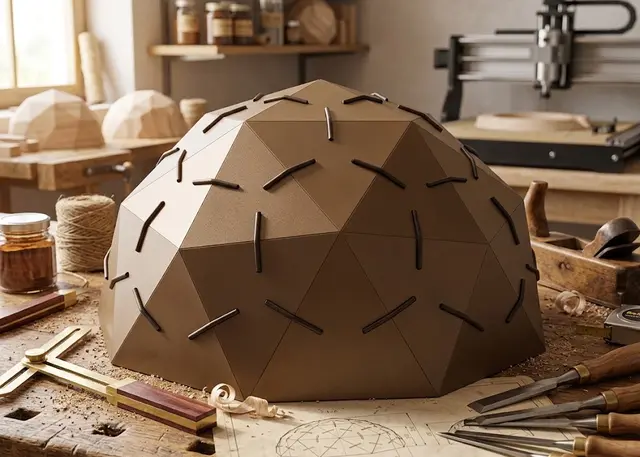 Geodesic dome A dome of triangles that clip together: pick the diameter and the frequency, and the pieces come out with the exact angles.
 -
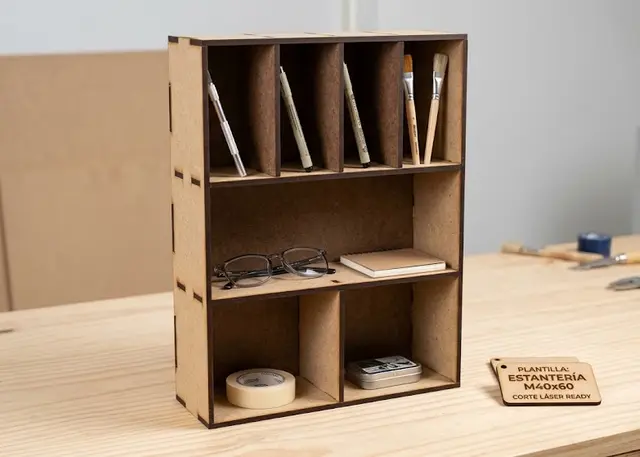 Shelving unit A made-to-measure shelving unit: you pick how many shelves, how tall each one is and how many bays it splits into.
 -
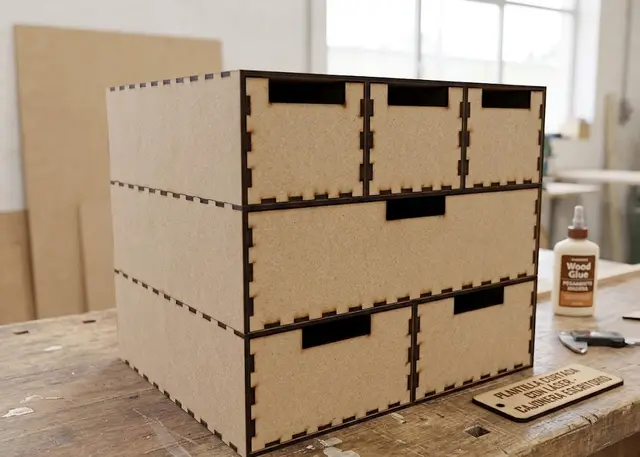 Desk drawer unit A made-to-measure drawer unit: you pick how many rows, how tall each one is and how many drawers fit in it.