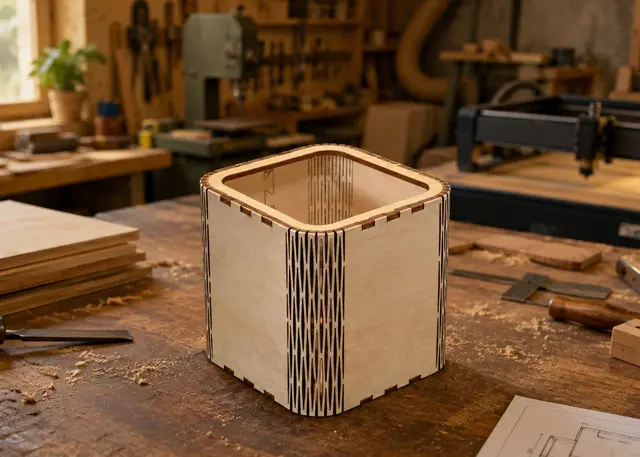
Curved corner box
A box with rounded walls: the wall bends on its own thanks to a living hinge cut into the MDF.
All four walls come out as a single strip with a living hinge, the length measured on the inner face, and a warning when the radius is too tight.
How it goes together
All four walls are a single strip. It is cut straight and bent at the corners: what looks like a grid of slots is a living hinge, and it works because each slot removes material exactly where the MDF would otherwise have to stretch. The bridges left between one slot and the next are what do the work.
The strip starts and ends in the middle of a side, not at a corner. The seam falls on a straight run, which is where you can clamp it against something solid; at a corner you would be holding two curved ends together while the glue sets.
The tabs are only on the straight runs. The strip has to bend at the corners, and a tab there would pin it against the base. That is why the curves of the base pass smooth, with no joint.
The radius has a minimum and it is worth respecting. The tighter the corner, the more each bridge is stretched; past a certain point the MDF cracks and snaps. The warning works out the minimum for your thickness. If you are close to it, bend slowly and help it along with a little steam.
The length of the strip is measured on the inner face. When it bends, the inner face is the one that sits against the base, and the one that has to go round exactly — the outer face stretches. Measured along the middle of the thickness, the strip would come out a few millimetres long on every corner.
Frequently asked questions
Curved corner box: what size can it be?
Every measurement is typed in millimetres and the drawing is redone as you type: width, from 60 to 1000 mm, depth, from 60 to 1000 mm and height, from 20 to 600 mm. Everything else — joints, dividers, holes — is worked out from those measurements.
Does it work for MDF, acrylic or plywood?
For any sheet your laser can cut: MDF, plywood, acrylic or thick card. What matters is the thickness, adjustable from 1 to 12 mm, and the kerf — what the beam eats away: the joints are drawn from those two numbers, so they push together without sanding.
What format does it download in?
SVG or DXF, your choice, in millimetres and at 1:1 scale. It opens as is in LightBurn, RDWorks, LaserGRBL, Inkscape, Illustrator or CorelDRAW, with nothing to scale or convert. Cutting and engraving come on separate named layers — “Cut” in red and “Engrave” in blue — so you set the power for each without separating anything by hand.
Do I have to pay to use it?
No. Curved corner box is one of the free ones: use it, adjust it and download it as many times as you like with a free account. No watermark and no missing pieces either.
Others you might need
-
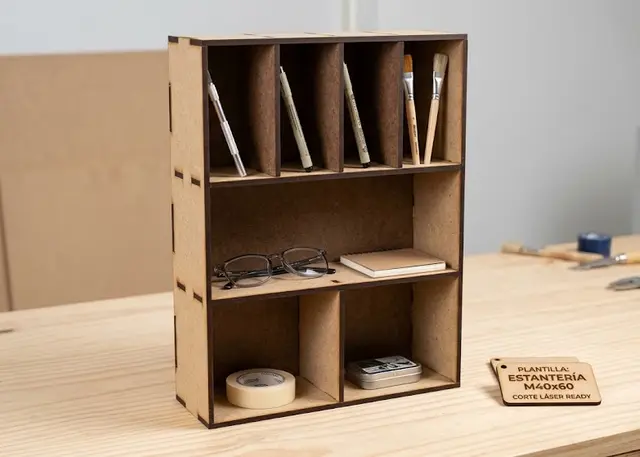 Shelving unit A made-to-measure shelving unit: you pick how many shelves, how tall each one is and how many bays it splits into.
 -
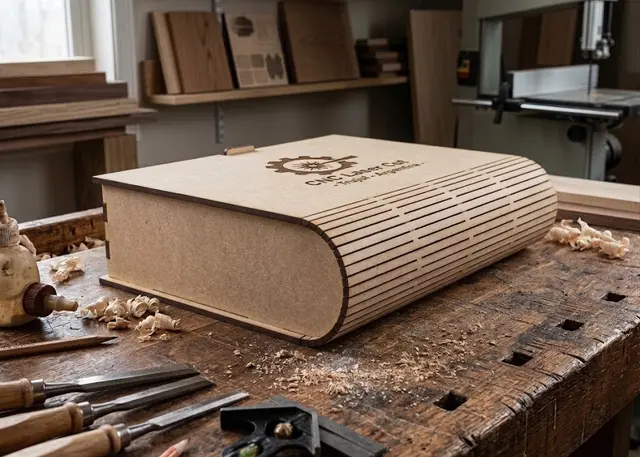 Book box A box shaped like a book: cover, curved spine and back in one piece, a tray with dividers and a wooden or magnetic catch.
 -
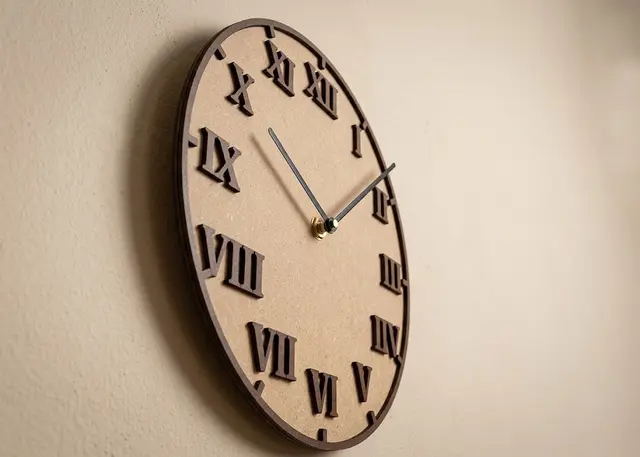 Clock face The face of a wall clock, with Arabic or Roman numerals, hour marks and minute marks.